
© Karel Calitz 2026
February 17, 2026
Build Stuff, Talk About It (Even When AI Helped)
About ten months ago, I built something I'm proud of. It's called the aboycalledhero block, a hero component for Plone's Volto frontend that does what most carousels promise but rarely deliver.
Build Stuff, Talk About It (Even When AI Helped)
Background images or video, smart button generation, and the option to pull directly from the page's own title, description, and headers. A flexible, good-looking landing section that editors can manage without needing a developer.
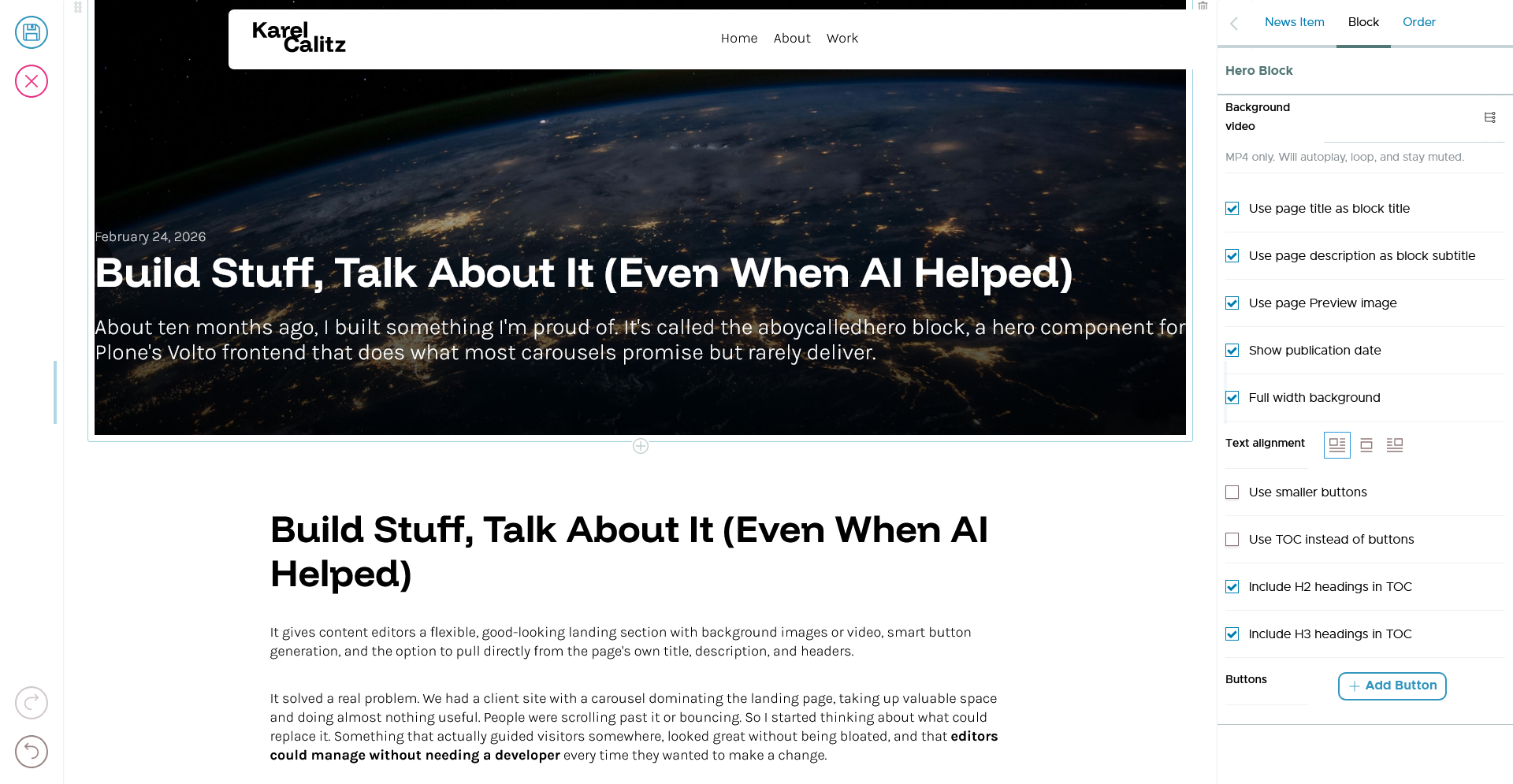
aboycalledhero Block solved a real problem.
A client's carousel was dominating the landing page, taking up space and doing nothing useful. People scrolled past it or bounced. So I started thinking about what could replace it, something that actually guided visitors somewhere and looked great without being bloated.
I'm proud of it because it works. It's now the go-to hero block across our client sites at Juizi, with variants built around what different clients liked. It's a genuine part of our toolkit.
Here's the part I didn't want to talk about: I built it with AI.
The quiet part
I used AI to help me build it. Started with one tool, moved to another on a friend's recommendation, and found a process that worked. But even as the output got better, I felt something unexpected. Not shame exactly, more a quiet lack of confidence. A sense that I was getting away with something.
There's a lot of noise online about AI-generated work, and most of it isn't kind. When you've been in design and front-end for over twenty years, there's a voice that says you should be able to do this yourself.
So I shared the block, but I didn't talk much about the process.
What actually happened
Here's what I've come to realise: I don't fully understand all the code the AI gives me. And that's okay.
What I do understand is what this block needed to be. I know what makes a hero section useful and what makes it decoration. I know how editors think, because I've spent years watching them work. I know that if you make something hard to manage, people stop managing it. I know that generating buttons from page headings gives visitors a reason to stay.
None of that came from the AI. The AI helped me turn ideas into code. I brought the thinking, the direction, the testing, and the care about whether the thing actually worked for the people who'd use it.
That's not cheating. That's building.
Not alone in this
I didn't do this in isolation. At Juizi, my colleagues were genuinely happy I could take an idea from concept to working block without waiting for the team at every step. It made me more self-reliant in a way that benefited everyone.
But the community around me matters just as much as the tools. The Juizi team and the broader Plone community are generous with their time, and honest about the quality of your work. Having people who will tell you when something isn't good enough is part of what makes the work trustworthy.
AI gave me speed. My community gives me standards.
The point
There's a phrase I keep coming back to: build stuff, talk about it.
I almost didn't follow my own advice here, because I was caught up in how I built it rather than what I built.
The aboycalledhero block exists because I had an idea, cared about making it work, and put it out there. The fact that AI was part of the process doesn't diminish that.
Build stuff. Be honest about the process. Talk about it anyway.
This is the first in a series of articles about my vibe coding experience, AI-assisted development, and what it means to care about the things you build.